 AstroloMap
What the Lines on the Map Actually Are
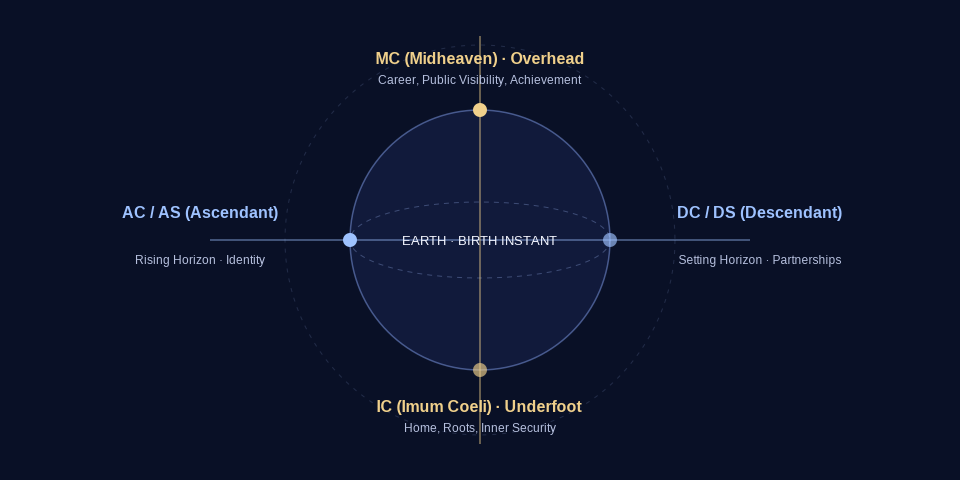
At the exact minute you were born, every planet occupied a specific spot in the sky relative to your birthplace. If someone had stood in another timezone at that same universal moment, those same planets would have appeared directly overhead, straight underfoot, rising in the east, or setting in the west.
Astrocartography (popularized by astrologer Jim Lewis in the 1970s as Astro*Carto*Graphy) simply maps those four positions onto a globe. Two types of geometry explain why the map looks the way it does: Midheaven (MC) and Imum Coeli (IC) lines drop straight north-to-south along meridians of longitude, because solar noon or midnight hits an entire longitudinal strip at once. Ascendant (AC) and Descendant (DC) lines sweep across continents in long S-curves, because Earth tilts on its axis and horizon rise/set times shift sharply by latitude.
Sources & Further Reading
- Jim Lewis & Astro*Carto*Graphy overview ↗ — Origin of modern 4-angle relocation maps in the 1970s
- Exact horizon formula in AstroloMap ↗ — cos(H) = −tan(lat) × tan(dec) using Astronomy Engine positions
Read the Angle First (AC, DC, MC, IC), Then the Planet
Most first-timers zoom straight onto a "Venus line" or "Jupiter line" and ignore the two letters printed after it. That gets people confused fast. Two cities can both sit on a Venus line and give you completely different years: Venus MC shows up in public reputation and creative work, while Venus IC tends to show up indoors through comfort, family life, and a slower daily pace.
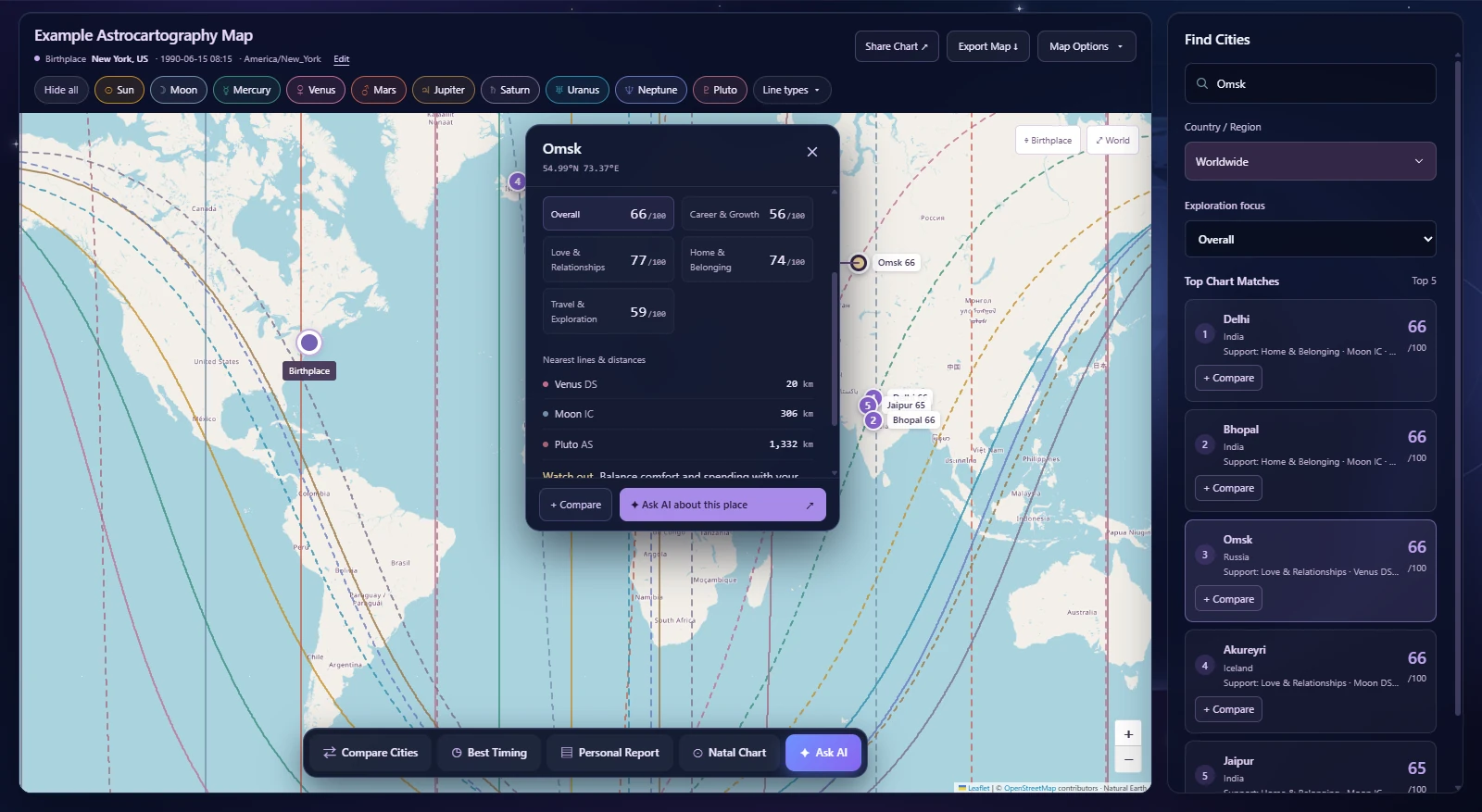
In the sample screenshot below (June 15, 1990, 08:15 in New York), Omsk sits just 20 km from Venus DS and 306 km from Moon IC. Look at the score card: Love & Relationships jumps to 77/100 and Home & Belonging hits 74/100, while Career & Growth stays average at 56/100. One planet, two supportive angles, very different life domains.
| Angle | Where It Is in the Sky | Line Style | Where You Notice It First |
|---|---|---|---|
| AC / AS | Rising in the east | Solid curve | First impressions, confidence, physical energy, starting fresh |
| DC / DS | Setting in the west | Dashed curve | Dating, marriage, business partners, who you attract 1-on-1 |
| MC | Directly overhead | Solid vertical line | Career momentum, visibility, reputation, public output |
| IC | Directly underfoot | Dashed vertical line | Housing, family roots, privacy, how relaxed you feel at home |
The 10 Planet Lines: Upsides and Catches
Color identifies the planet, solid vs. dashed identifies the angle. Every line carries real tradeoffs in lived experience rather than a simple "good" or "bad" label:
- Sun (☉): Clearer confidence, leadership, and visibility. Catch: hard to stay low-key or blend into the wallpaper when you are tired.
- Moon (☽): Everyday habits click sooner; cities feel unusually personal. Catch: your moods rise and dip faster with local stress.
- Mercury (☿): Busy conversations, writing, short trips, networking. Catch: mental restlessness if you never turn work off.
- Venus (♀): Aesthetic ease, warm social circles, dating, hospitality. Catch: easy to drift into comfort and procrastinate on tough deadlines (full Venus line guide).
- Mars (♂): Urgency, courage, physical energy, getting unstuck. Catch: arguments, impatience, and burnout if you stay locked in sprint mode (full Mars line guide).
- Jupiter (♃): Wider opportunities, travel, generous timing, optimism. Catch: overcommitting or spending ahead of reality (full Jupiter line guide).
- Saturn (♄): Slow credibility, discipline, lasting credentials. Catch: few shortcuts, heavier duties, and visible friction early on (full Saturn line guide).
- Uranus (♅): Sudden pivots, eclectic friends, breaking stale routines. Catch: restless sleep and plans changing every six months.
- Neptune (♆): Creative flow, music, photography, spiritual openness. Catch: foggy boundaries, flaky commitments, or over-idealizing a move.
- Pluto (♇): Intense transformation, deep ambition, zero small talk. Catch: power struggles and all-or-nothing chapters that rarely feel casual.
How Close Is "Close Enough" — Plus Two Map Blind Spots
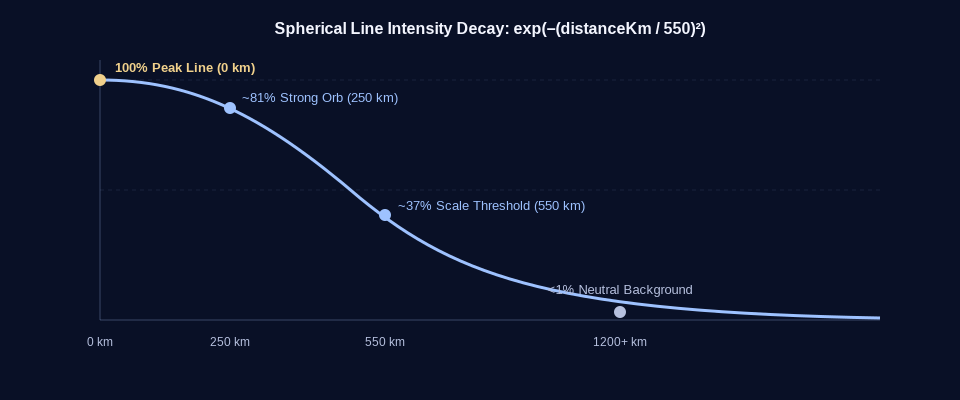
You do not need a line slicing straight through downtown to feel it. A line works like a wide highway rather than a laser beam. AstroloMap models distance with a 550 km Gaussian curve, which works out neatly against real geography: inside 150 km (around a two-hour drive) sits right in the core; 150 to 350 km is still clearly active during a trip or move; 350 to 550 km acts as mild background flavor; beyond 1,200 km, a line contributes less than 1% and you can safely ignore it.
Two things catch beginners off guard when they pick a city from line distance alone. First, Parans: latitude crossings where two completely different planet lines intersect east-to-west around the globe, so a seemingly peaceful Venus city might share a latitude with Saturn or Mars. Second, your local Relocation Chart: keeping your exact birth time while swapping coordinates shifts planets into new houses, which can move an active planet into a quieter 12th house or a busier 10th house.
| Distance from Line | Relative Strength | Practical Takeaway |
|---|---|---|
| 0 – 150 km | 93% – 100% | Core zone; hard to miss the planet-angle theme |
| 150 – 350 km | 67% – 93% | Strong regional pull across a neighborhood or metro area |
| 350 – 550 km | 37% – 67% | Secondary flavor; matters mostly when other lines support it |
| > 1,200 km | < 1% | Outside effective orb; look elsewhere for astrological contrast |
Sources & Further Reading
- Astronomy Engine (CosineKitty) ↗ — Geocentric ephemeris used for line geometry
- NASA JPL Horizons System ↗ — Independent solar and lunar coordinate verification
- Full Planetary Lines Directory ↗ — Compare all 10 bodies and open individual planet guides
Frequently Asked Questions
How close to a line do you need to live to feel it in astrocartography?
Core line influence sits inside 0–150 km (93%–100% strength) and stays clearly active out to ~350 km. Between 350 km and 550 km it adds gentle background tone, and past 1,200 km intensity drops below 1%.
Why are AC and DC lines curved while MC and IC lines are vertical?
MC and IC trace meridians of longitude where a planet sits directly overhead or underfoot at a single universal instant. Rising (AC) and setting (DC) depend on horizon geometry cos(H) = −tan(lat) × tan(dec), which bends across latitudes.
What does a dashed line vs. solid line mean on AstroloMap?
Solid lines indicate outward, visible angles (AC/AS and MC). Dashed lines mark relational and private angles (DC/DS and IC).