 AstroloMap
Two Pieces to Every Line: Planet = Flavor, Angle = Stage
A natal birth chart freezes the sky over one hospital or town. An astrocartography map asks the inverse question: at that exact UTC birth minute, everywhere on Earth had a different horizon and overhead point. Four key positions matter:
- Ascendant (AC / AS): planets rising on the eastern horizon — changes how you walk into rooms, energy levels, and first impressions.
- Descendant (DC / DS): planets setting in the west — shifts dating, marriage, business partners, and who gets drawn toward you.
- Midheaven (MC): planets directly overhead — amplifies career momentum, public visibility, reputation, and leadership.
- Imum Coeli (IC): planets directly underfoot — shapes domestic peace, apartments, family dynamics, and private recovery.
Reading Solid vs. Dashed Lines Across the 4 Angles
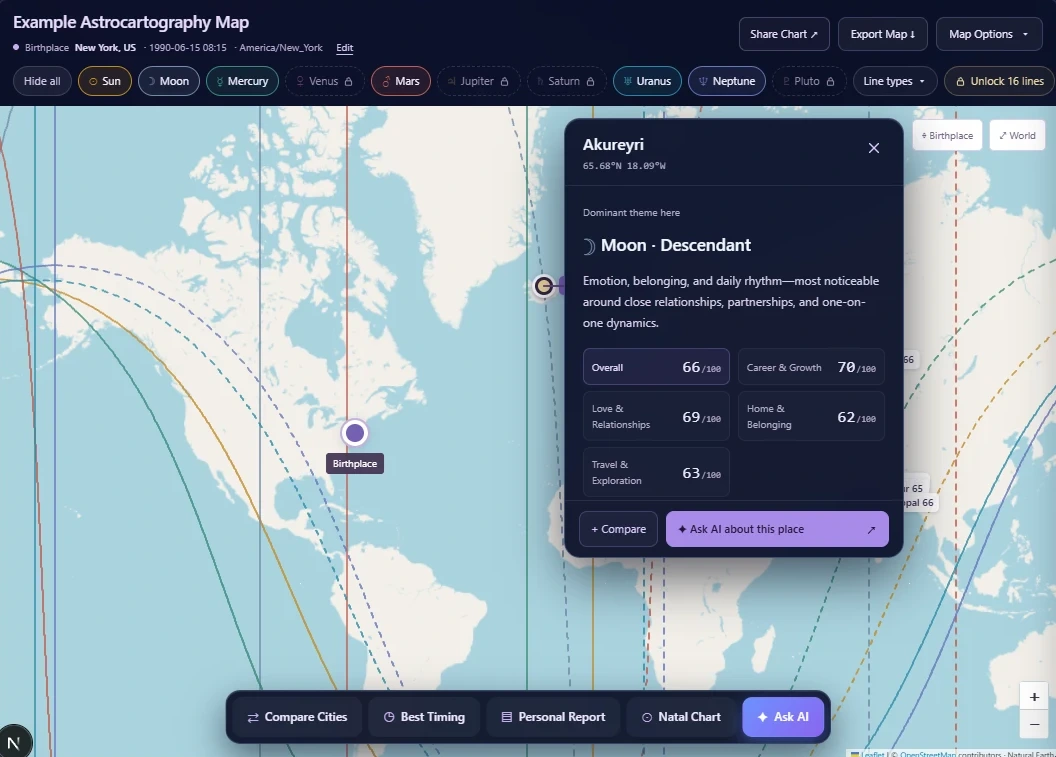
On AstroloMap maps, outward and public angles (AS and MC) draw as solid paths, while relational and private angles (DS and IC) draw as dashed paths. Horizon curves (AS/DS) sweep cleanly across longitudes because rise/set geometry bends with latitude; meridian lines (MC/IC) run straight north to south.
| Line | Angle | Life Domain & Focus |
|---|---|---|
| AS | Ascendant | self-presentation, vitality, and fresh starts |
| DS | Descendant | close relationships, partnerships, and one-on-one dynamics |
| MC | Midheaven | career direction, public image, and achievement |
| IC | Imum Coeli | home, inner security, and everyday living |
Strongest Planet-Angle Pairings by Life Chapter
Instead of chasing whichever bright line crosses a warm beach, match the planet and angle to what you actually want the next two years to produce:
| Goal for This Chapter | Standout Lines | Worth Knowing Upfront |
|---|---|---|
| Visible Career Leap | Sun MC, Jupiter MC, Mars MC | High output and exposure; leave room to recharge outside work |
| Creative Work & Lifestyle Ease | Venus MC, Venus AS, Sun AS | Doors open socially; guard against drifting into comfortable procrastination |
| Dating & Deeper Partnerships | Venus DC, Moon DC, Jupiter DC | Warm chemistry and loyalty, unless Saturn or Pluto crosses the latitude |
| Rooted Home & Family Calm | Moon IC, Venus IC, Jupiter IC | Restorative daily rhythm; usually quieter on fast career ambition |
| Discipline & Long-Horizon Craft | Saturn MC, Saturn IC | Slow, durable payoff after patient effort; light on instant luck |
| Reinvention or Big Shakeup | Uranus AS, Pluto MC, Mars AS | Fast breakthroughs and identity shifts; rarely subtle or relaxed |
All 10 Celestial Bodies (With Dedicated Deep Dives)
Explore every mapped planet below—including its typical catch and links to full AC, DC, MC, and IC guides for the six lines people relocate around most often.
Why Overlapping Lines Don’t Double-Count in Scoring
AstroloMap computes exact 3D spherical distance from each city to every half-great-circle line (mean Earth radius 6,371.0088 km) and scales strength smoothly using a 550 km falloff curve. When two different angles of the same planet fall near one metro region, scoring retains the strongest single contribution per planet for each goal rather than inflating totals twice.
Sources & Further Reading
- How to Read an Astrocartography Map ↗ — Step-by-step walkthrough of distance bands, Parans, and examples
- Where Should I Live Based on Astrology? ↗ — Filtering 34,249 GeoNames cities by career, love, or home
- Full Calculation Formulas & Weights ↗ — Exact spherical geometry and goal weighting rules
Frequently Asked Questions
How many planetary lines are on an astrocartography map?
There are 40 primary angular lines (10 celestial bodies from Sun to Pluto × 4 horizon/meridian angles: AC/AS, DC/DS, MC, and IC), plus 240 angular aspect branches (60°, 90°, 120°) and east-west Paran latitude crossings.
What is the difference between a Venus MC line and a Venus IC line?
Both carry Venus themes (ease, taste, attraction), but the angle chooses the stage: Venus MC turns active in public work, reputation, and creative visibility, whereas Venus IC turns active indoors around home aesthetics and domestic calm.